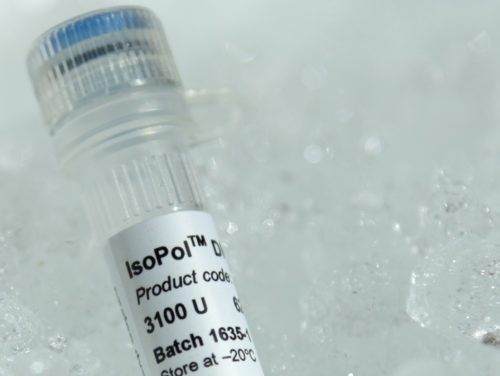

Enzymes that Unlock
Your Next Discovery
0
Isothermal High Temperature Range

Isothermal High Temperature Range

IsoPol® BST⁺ For point-of-care diagnostic assays

Isothermal High Temperature Range

IsoPol® BST⁺ Isothermal High Temperature Range

OverView

These DNA polymerases are ideal for Isothermal Amplification

IsoPol® BST+ is a heat-tolerant BST polymerase (large fragment) with enhanced strand-displacement activity. IsoPol® BST+ is active from 25 to 65°C. It is lacking 5’-3’- and 3’-5’-exonuclease activity.

Key features

  • IsoPol® BST+ lacks 5’-3’- and 3’-5’-exonuclease activity.
  • Inactivation - IsoPol® BST+ is completely inactivated after one minute incubation at 95°C
  • Enhanced strand displacement and processivity.
  • Increased salt tolerance.

IsoPol BST+ Glycerol FREE 

Is the popular choice for isothermal applications such as LAMP and RT-LAMP at point-of-care diagnostics for its superior amplification performance and robustness. The enzyme is offered in a 1X storage buffer at a concentration < 300 U/µl

IsoPol BST+ High Concentration Glycerol FREE

(IsoPol BST+ HC Glycerol FREE) is used to ease the product development processes in sequencing technologies, solid phase amplification and several isothermal technologies. Same performance as IsoPol BST+ (i.e., high processivity, relative SDA, and relative activity) with the only difference that it is offered in a 2X storage buffer at a concentration > 500 U/

Key features

  • High concentration
  • High purity
  • Lyophilisation and automation friendly

Figures
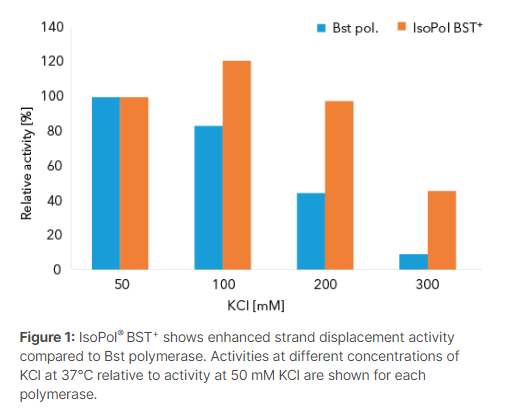
Isothermal High Temperature Range - Figure 1
Figure 1. IsoPol® BST⁺ shows enhanced strand displacement activity
Isothermal High Temperature Range - Figure 1

IsoPol® BST+ shows enhanced strand displacement activity compared to Bst polymerase. Activities at different concentrations of KCl at 37°C relative to activity at 50 mM KCl are shown for each polymerase.

Isothermal High Temperature Range - Figure 2
Figure 2. IsoPol® BST⁺ tolerates higher concentrations of salt compared to Bst polymerase.
Isothermal High Temperature Range - Figure 2

IsoPol® BST+ tolerates higher concentrations of salt compared to Bst polymerase. Polymerase activity of Bst and IsoPol™ BST+ as function of NaCl data represented relative to highest activity of each polymerase.

Isothermal High Temperature Range - Figure 3
Figure 3. IsoPol BST⁺ has superior strand displacement activity
Isothermal High Temperature Range - Figure 3

IsoPol BST+ has superior strand displacement activity compared to Bst LF. SDA was measured at 37°C using a nicked dsDNA template.
Isothermal High Temperature Range - Figure 4
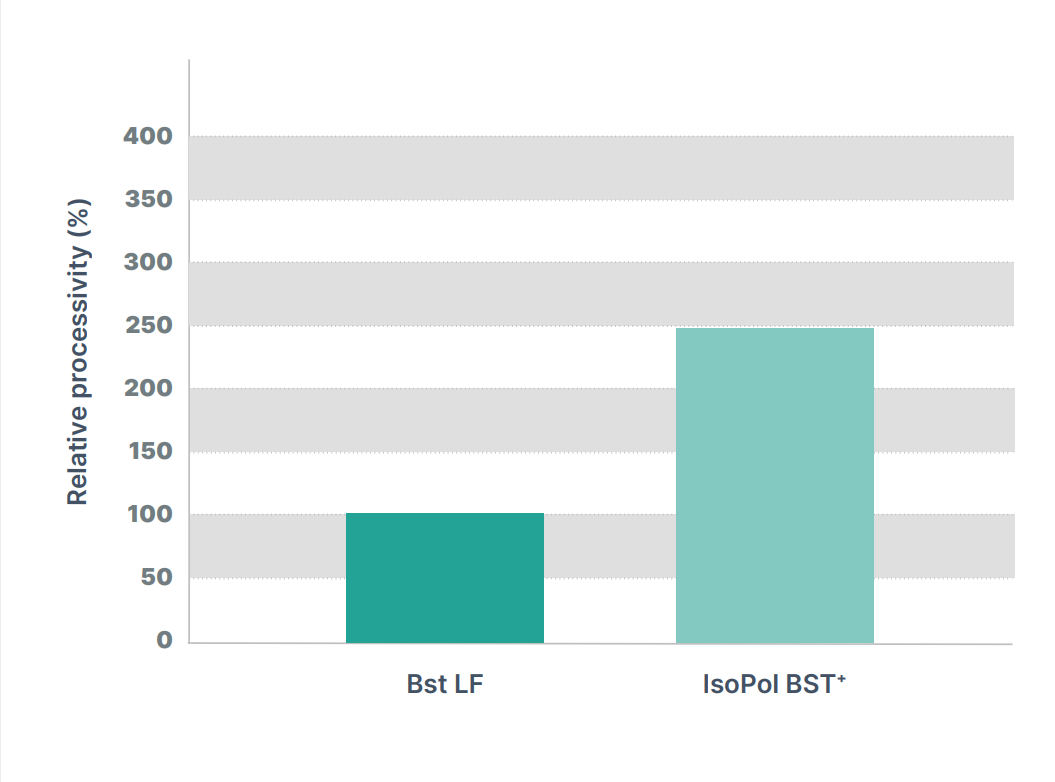
Figure 4. IsoPol BST⁺ has enhanced processivity compared to Bst LF
Isothermal High Temperature Range - Figure 4

IsoPol BST+ has enhanced processivity compared to Bst LF. Processivity was determined at 37°C using a primed circular ssDNA.

Isothermal High Temperature Range - Figure 6
Figure 6. IsoPol BST⁺ provides superior time-to-results in RT-LAMP
Isothermal High Temperature Range - Figure 6

IsoPol BST+ results in faster detection of target in both LAMP and RT-LAMP. When IsoPol BST+ was used in LAMP and RT-LAMP, time to results were strongly reduced compared to the non-engineered backbone, Bst LF. IsoPol BST⁺also significantly outperformed engineered versions of Bst LF from another vendor (Bst Vendor A). LAMP was used to detect 0.05 ng of λ DNA (Fig 5).RT-LAMP was performed with AMV RT to detect 10 ng of MS2 RNA template (Fig 6). LAMP and RT-LAMP were performed at 65°C.
Isothermal High Temperature Range - Figure 7
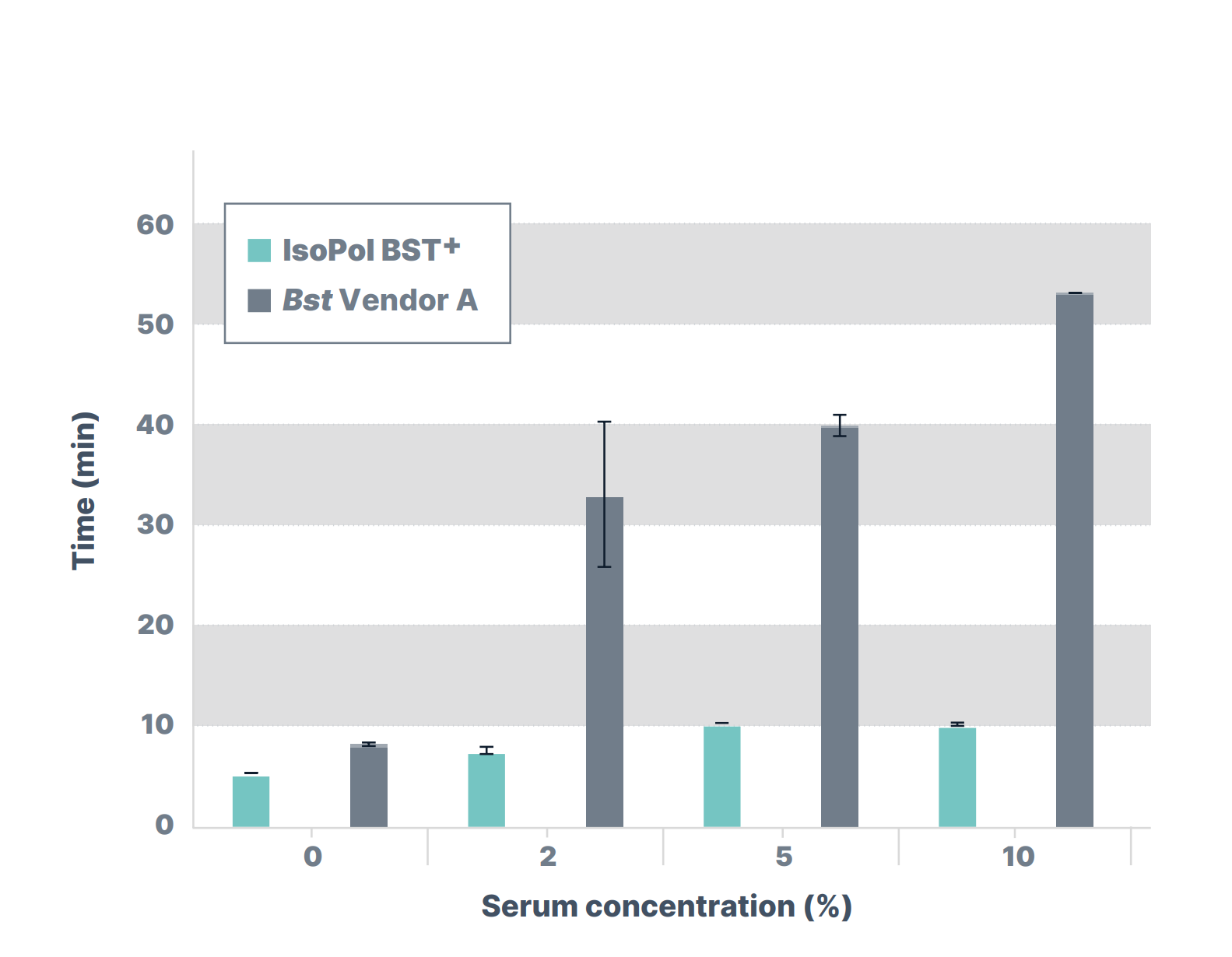
Figure 7. IsoPol BST⁺ tolerates serum
Isothermal High Temperature Range - Figure 7

IsoPol BST+ polymerase has high tolerance to matrix effects. LAMP was performed using λ DNA template in presence of human serum demonstrating that IsoPol BST+ maintains high activity over a wide range of serum concentrations. No amplification was detected in the absence of template.

Properties

Specifications
Unit Definition

One unit is defined as the amount of enzyme that will incorporate 10 nmol of dNTP into acid insoluble material in 30 minutes at 65°C.

Strand-displacement activity

IsoPol® BST+ exhibits enhanced strand-displacement activity compared to Bst polymerase.

Suggested reaction conditions

IsoPol® BST+ is active at pH 8.5 in buffer supplemented with 5-20 mM MgCl2 and 50-350 mM salt (NaCl or KCl), at 65°C.

Storage and Stability

IsoPol BST+ is stable at -20°C for up to 2 years in the supplied storage buffer. IsoPol BST+ Glycerol FREE and IsoPol BST+ High Concentration (HC) Glycerol FREE are stable at 4°C for up to 2 years in the supplied storage buffer.

Quality Control

ArcticZymes is dedicated to the quality of our products. IsoPol® BST⁺ is manufactured at our ISO 13485 certified facility in Norway.

Recommended Protocols

Ordering Info

Quantity
Product Name
SKU
Pack Size
Concentration
Price
1
72100-201
AZscript RT
72100-201
10000 U
200 U/μl
$ 119.00 USD
Request Quote
1
80200-250
Heat&Run gDNA Removal Kit
80200-250
250 rxn
$ 631.00 USD
531.00
631.00
Request Quote
1
80400-100
PCR Decontamination Kit
80400-100
100 rxn
$ 107.00 USD
Request Quote
1
71600-201
ArcticZymes Proteinase
71600-201
50 U
>200 U/ml
$ 150.00 USD
127.00
150.00
Request Quote
2
80400-500
PCR Decontamination Kit
80400-500
500 rxn
$ 431.00 USD
Request Quote
2
80200-50
IsoPol™ BST⁺
80200-50
50 rxn
$ 161.00 USD
135.00
161.00
Request Quote
2
72100-100
AZscript RT
72100-100
As per request
As per request
$ 0.00 USD
Request Quote
2
71600-110
ArcticZymes Proteinase
71600-110
1000 U
>200 U/ml
$ 1,375.00 USD
1151.00
1375.00
Request Quote
3
71600-100
ArcticZymes Proteinase
71600-100
As per request
>200 U/ml
$ 0.00 USD
Request Quote
4
71610-100
ArcticZymes Proteinase Glycerol-FREE
71610-100
As per request
>200 U/ml
$ 0.00 USD
Request Quote
Note: Article no. 71502-202 and 71502-120 are provided with IsoPol® BST+ 10X Buffer and MgSO4 .
Add To Cart
Right arrow.

Publications

We are using a plug-in called Bioz.com who will provide a script to add to Webflow. This will pull in all the publications.

We don’t believe this will impact the overall layout but it may offer some opportunites for example adding a «Citations» button next to the ordering info. We’ll find out later in August as form the relationship

No items found.
No items found.

FAQ's

Is a licence required for this product?
Compatibility with buffer formulations?
What are the abbreviations of the applications?
What about Inhibitor Tolerance?
What about strand displacement and processivity?